


A few weeks ago, a group building a new entrepreneurial initiative asked me a bunch of questions about what changes for organizations and product development - from an entrepreneurial standpoint - now that agents enter the scene and new economic ecosystem agreements can form.
For much of the history of the firm, coordinating independent actors required building expensive institutions. Because market-based coordination was too costly, transactions historically moved inside organizations. Platforms later offered a possibility between markets and firms: actors stay formally independent while a central infrastructure handles identity, matching, payments, reputation, rules, and disputes.

That model produced some of the largest businesses of the last twenty years because coordination remained difficult: whoever absorbed that cost could also capture a significant share of the value.
I feel AI and agents can obviously change this calculation.
An agent can read a system and help build explicit descriptions of actors, offerings, needs, conditions, and commitments; it can help build and maintain relationships that previously required substantial human coordination. This does not remove the need for institutions, governance, or trust, but it reduces how much coordination a central actor must continuously mediate and produce.
As ecosystems become more legible, a growing share of their coordination capacity can become distributed and the - still relevant - role of a central organizer requires less energy.
Legibility, in some ways, becomes infrastructure.
From composability to constitution
In TTB5, Modularity, Recombination and the New Architecture of the Firm, I argued that distributing autonomy without a shared language for units to form agreements leaves most architectural power at the center.
If every new collaboration needs somebody to translate, authorize, and reconfigure, autonomy stays limited.
A recent podcast conversation with Clay Parker Jones, who now leads organizational design/development at Airbnb after years close to self-organization, pushed this further. He acknowledged that the movement has sometimes underestimated structure. Inside large organizations, formal authority, processes, culture, interests, and a mass of tacit rules coexist.
The Boundaryless Conversations Podcast Season 8 is back! Subscribe on Youtube or Spotify.
Then we started talking about making contracts explicit.
An internal contract, an API, an open-source license and a product interface belong to the same family of objects.
Each of these artifacts describes what one party offers, what another can expect, what conditions apply, and what falls outside the agreement.
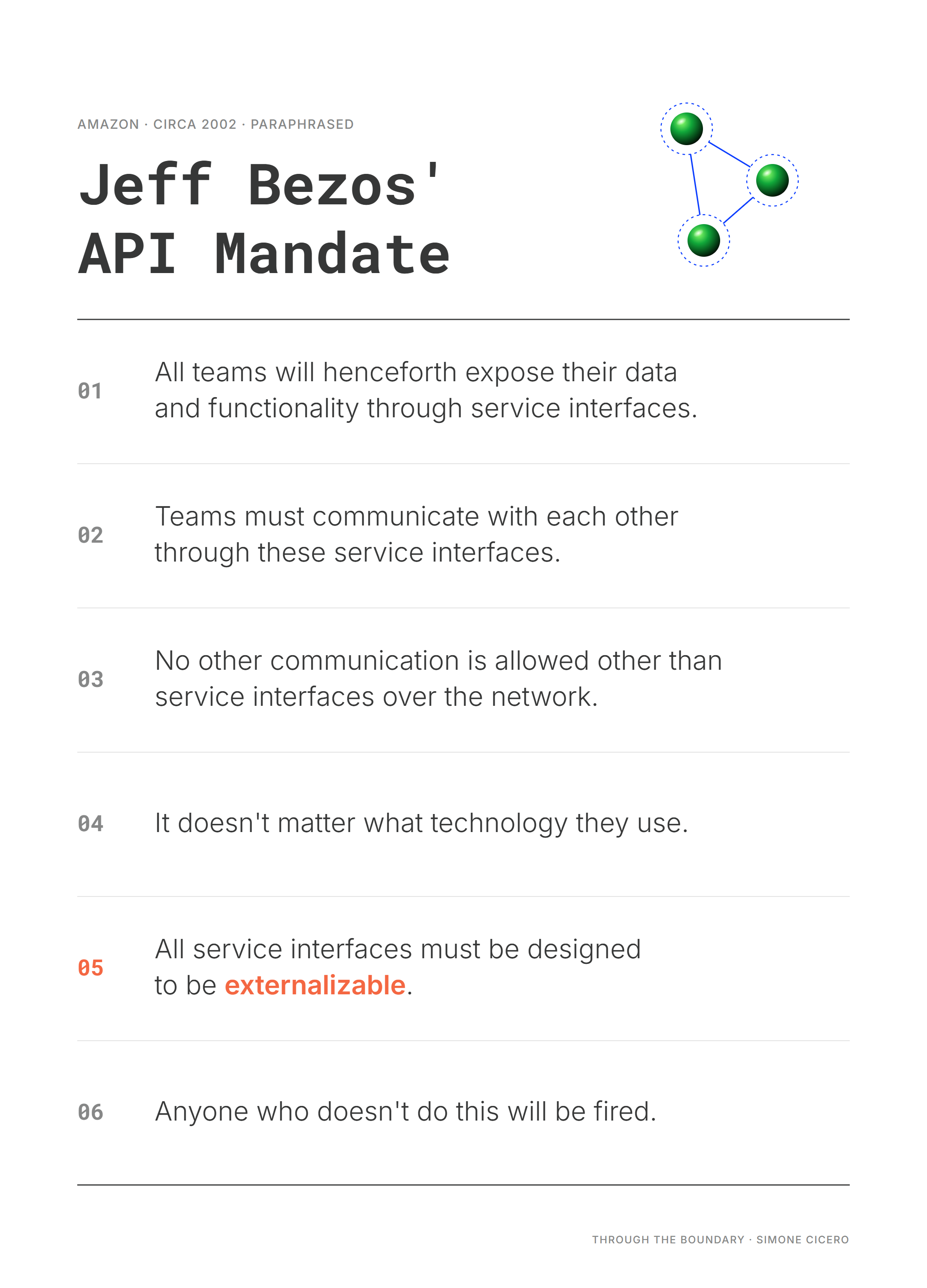
In 2002, Jeff Bezos required Amazon teams to interact only through service interfaces; he did more than choose a software architecture. He was making the boundaries that organizational proximity, tacit knowledge, and managerial authority had been managing… explicit.
An important consequence of making boundaries explicit is that all kinds of debt become visible: dependencies, ambiguities, decision rights, and promises that lived in informal relationships. Most importantly, power gets redistributed, most often in value-driven ways.
We framed it well in the conversation with Clay:
“Contracting and platforming are political activities, because they affect how power is distributed, legitimized, exercised, and contested.”
A shared grammar does more than help modules compose: it gives constituents of a system a way to see the relationships they are part of, negotiate their place within them, and participate in their transformation; in this way, legibility can become an affordance for collective agency.
One company I work with has been running its business for fifty years, and regulators are now pushing for open standards at one key interface. Everything around that request is being restructured, and profits are migrating. When a policymaker writes an interface, everyone recognizes it as a political act. It is no different when a company writes one internally.
Who gets to write the language? And how does advantage accrue?
In TTB6, Open Core Is Everyone’s Playbook, I argued that as software becomes cheap, strategic power migrates toward the shared grammar of the ecosystem.
If many organizations adopt the same ontology, workflows, protocols, or categories, whoever helps define them also helps construct the market that forms around them.
Today I would draw a distinction I did not make with enough precision: constitutive power and economic defensibility are different things.
A grammar certainly carries constitutive power. Making things more clearly contractable and modular, it determines what the system can see, what is easy to express, what becomes normal and what stays an exception, but it does not guarantee that whoever wrote it holds a defensible economic position.
So it was interesting to see how my friend Sangeet Paul Choudary recently raised an objection to the modularity narrative in one of his articles. In the conversation, he suggests modularity worked partly because coordinating modules was expensive; but when AI reduces that cost, he suggests that advantage can shift toward whoever controls the learning loops that cut across modules.
His example, Shein, is intuitive: social signals, design, small-batch production, market testing, supplier allocation and replenishment all sit inside one learning loop, and the advantage is the ability to learn across those boundaries.
The same can happen across an ecosystem of different software systems. An intermediary begins by translating between incompatible systems and gradually becomes the place where information and decisions converge. Translation - according to Choudary - produces an opportunity for governance.
That is a serious counter-thesis to the idea that AI leads toward ever more decentralized organizations and ecosystems, but my take is that both dynamics happen.
Learning loops and consequence loops
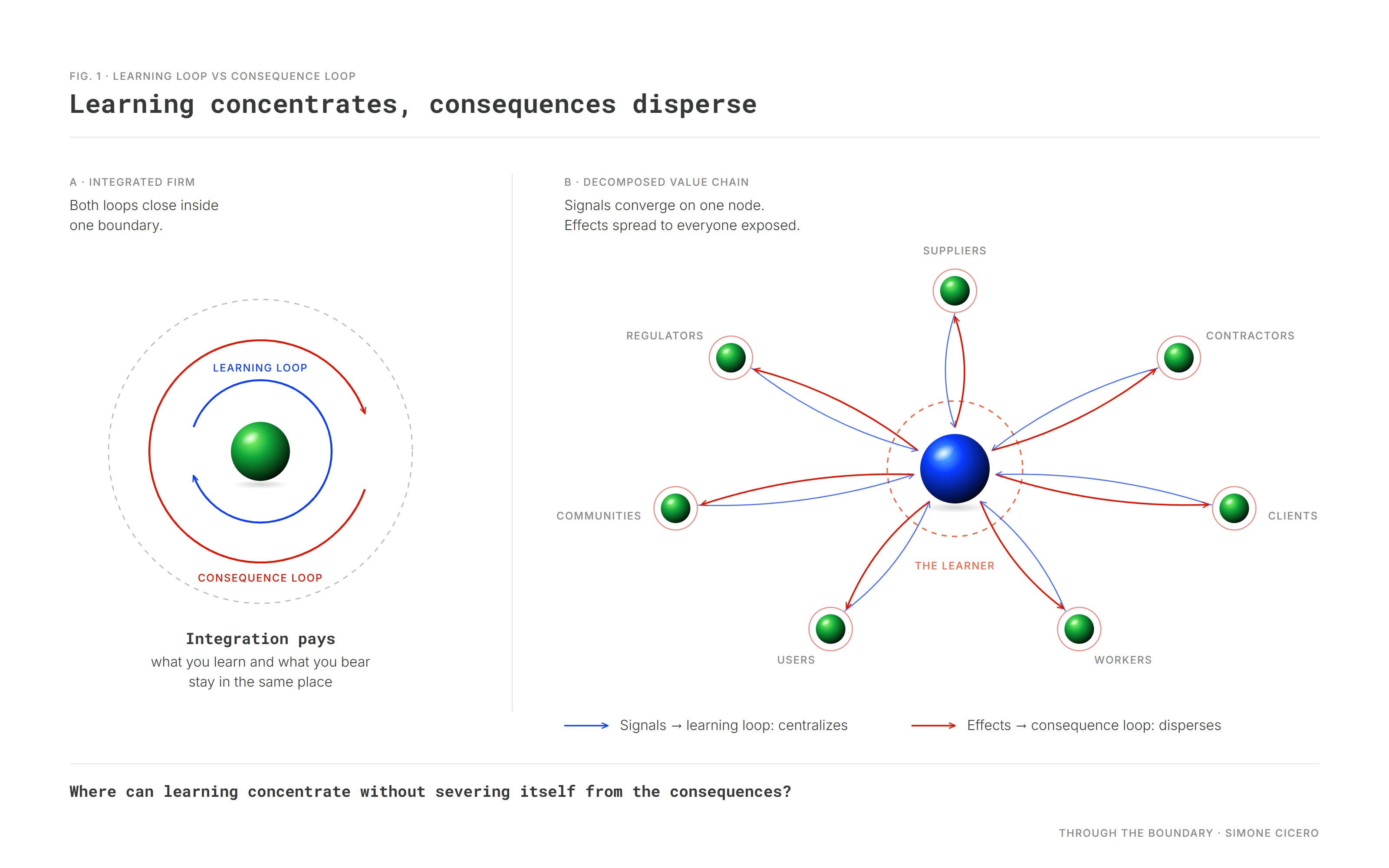
I believe that two feedback circuits run through a value chain. One carries information back into decisions: signals are observed, interpreted, and used to change what happens next. I will call this the learning loop.
The other carries the effects of those decisions back to the actors exposed to them: revenues, losses, operational failures, liability, damaged relationships. This is the consequence loop.
The integration capability Sangeet proposes as an opportunity for governance becomes especially powerful when learning and consequence loops close largely within the same organizational boundary. But this condition - I suspect - is becoming increasingly rare: as technology becomes cheaper and more widely available, capabilities that once had to be integrated inside a single firm can increasingly be performed by independent actors; this is exactly the thesis I presented in TTB 2 - After the Platform, where I explained that:
As digitalization moves into real-world industries (energy, mobility, healthcare...), markets are too crowded, open, participatory, and filled with incumbents holding many value chain pieces that a wannabe platform strategy can’t wish away.
The posture that fits this new environment is more systemic and modular: a clear reading of the existing ecosystem, an honest accounting of your fit, plus a portfolio of moves that provide the right value to the right people.
In a few words: as the number of economically meaningful parts in the system grows, organizational power shifts with it.
Some actors may still acquire a privileged view across the system. They can observe signals from multiple nodes, translate between them, coordinate decisions, and improve the learning loop.
But…
the consequence loop does not necessarily recentralize with the learning loop.
The key point is that as more parts of the value chain become independent, the consequences of a decision are distributed across more actors: suppliers, contractors, clients, workers, users, communities, regulators. The system may therefore become more centralized in what it can know while becoming more distributed in who bears the effects of what it decides.
This creates a different organizational problem: the more technology lets the system decompose into autonomous parts, the more important this problem becomes.
Every meaningful decision weighs trade-offs.
(Speed against quality, cost against resilience, immediate margin against a future relationship)… And while information helps to see those trade-offs and evolve the architecture of the system, it’s Exposure that helps to value them.
The challenge is then no longer only how to improve the learning loop, but how to govern systems in which decision-making power can concentrate while exposure to consequences continues to disperse.
The strategic question, then, is not simply whether firms should integrate or ecosystems should decentralize. It is where learning can concentrate without severing itself from the consequences that remain distributed across the system.
Control points will cost more
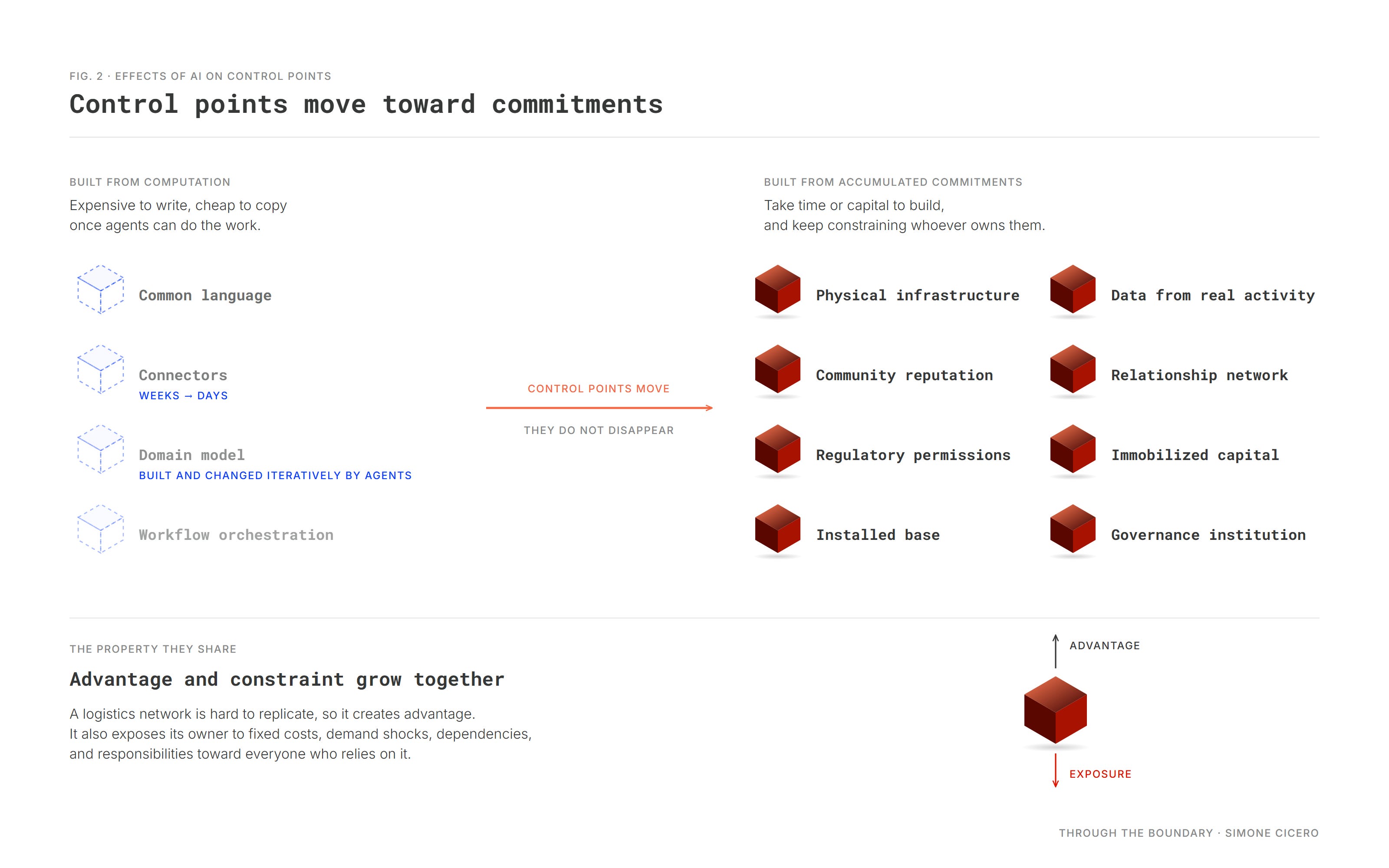
For years, control positions rested on capabilities that computation - in the form of software or other knowledge assets - made expensive. Writing a common language, building connectors, modeling a domain, and orchestrating workflows took capital and time, and replicating them cost enough to protect whoever got there first.
Part of that advantage is clearly eroding: integration software that took weeks now takes days. Agents can build and modify a conceptual model iteratively. A small organization can manage informational complexity that a few years ago required a much larger structure: control points do not disappear, but they move, and what makes them durable changes.
Physical infrastructure is the obvious example and far from the only one. Years of accumulated data from real activity, a reputation inside a community, a network of relationships, regulatory permissions and policy advocacy, immobilized capital, an installed base and an institution of governance are all equally hard to reproduce.
The control points that resist AI share one property: they are costly accumulated commitments.
They take time or capital to build, and they keep constraining whoever owns them.
Example: Amazon has invested for years in its logistics network. It is hard to replicate, and it creates advantage. But it also exposes Amazon to fixed costs, demand shocks, dependencies, and responsibilities toward the many actors who now rely on it. Advantage and constraint grow together.
In the end, in TTB6 I argued that a semantic commons can become an important institutional asset without becoming an ownable moat for whoever first authored it: the moat, where one exists, may emerge elsewhere: in the commitments accumulated to make that grammar useful in the world.
Facilitate the commons, build the implication
In today’s world, many ecosystems already have actors, resources and needs. What's often missing is a shared enough description of problems, relationships, and a set of collaboration possibilities, a collaboration language, for the players to see an evolutionary trajectory and walk it as a system: this often applies even inside single organizations (for how much the boundaries of a single organization still count: my bet, not much).
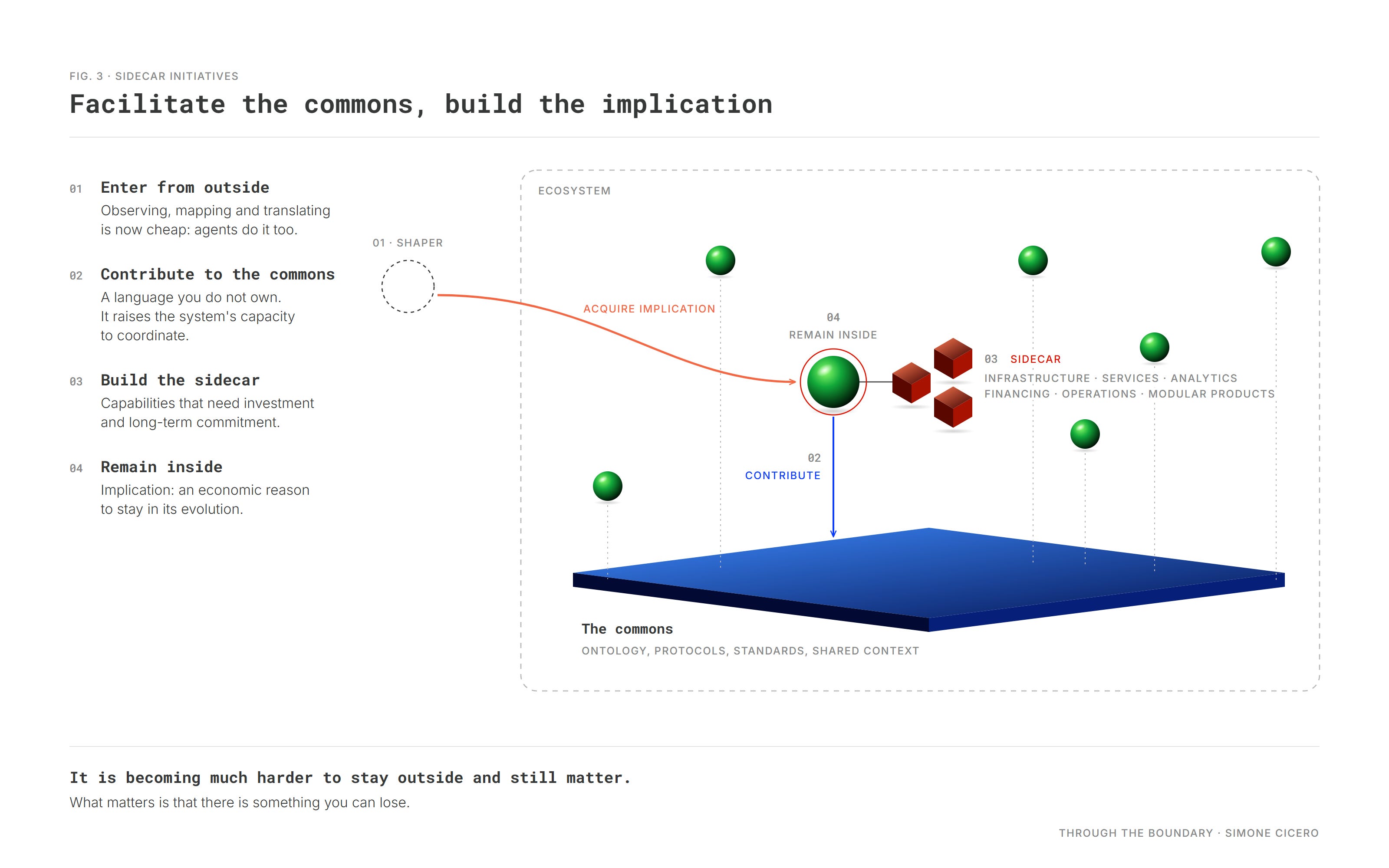
An organization can facilitate the construction of an ontology layer, protocols, and standards, and an engine of shared contexts that lets the ecosystem become legible to itself, build agreements, and innovate on use cases more easily. In most cases, that language should remain a commons: its usefulness increases when the actors who depend on it can participate in its evolution.
This limits the possibility of using the grammar itself as the main mechanism for appropriating value.
A sidecar part of the strategy can be building, inside that same ecosystem, capabilities that require investment and long-term commitments. These are infrastructures, specialized services, analytical capability, financing, operations, or the modular products that make the language operational. In a few words: contribute to a language you do not own while building a portfolio through which you become exposed to that system. The first increases the ecosystem’s capacity to coordinate; the second creates an economic reason to stay involved in its evolution.
It also answers what TTB6 left open: who maintains the commons?
A neutral steward may not be enough.
Sustainable governance probably requires participants who have something “at stake” in the effects of the language they govern.
Enter from outside, remain inside
I feel that the same dynamic runs through the debate about people inside agentic organizations.
The common response to growing AI capability is to move people toward more abstract work, defining systems, orchestrating agents, designing frameworks, and supervising. But agents already write specifications, decompose problems, and produce operating models, which is much of the abstraction we would have called strategic a few years ago. Thus, looking for a thesis of what it means to be human in the organization by abstracting at higher meta levels may be delusional. Agents are masters at systems thinking.
Keeping our ability to do meta-design remains necessary even in symbiosis with agents: complex systems need grammars, permission structures, interfaces and mechanisms through which they can evolve - and we need to keep them legible and human-interpretable.
But what agents cannot really do is separate us permanently from the contexts where those conditions produce effects and take on them.
A good architecture makes it easier for people to take initiative, form commitments and alter the relationships they are part of, so its value is eventually whether it moves agency back into the players in the context instead of extracting it toward another layer of supervision.
None of this means an ecosystem can only be changed from inside. Regulators, consultants, entrepreneurs, standards bodies, and new entrants introduce languages and infrastructures that change an industry, and platform history is full of outsiders who redesigned a market because they saw what incumbents could not.
But the outsider, the “shaper” position is just becoming less defensible as a permanent one.
Observing a system, synthesizing it, translating between its participants, and producing a framework used to be scarce: now agents can move through documentation, interviews, databases, and workflows, propose taxonomies, map dependencies, and generate translations. That reduces the value of actors who live exclusively in the mediation layer.
So if you approach an ecosystem’s set of opportunities from outside, you need to progressively acquire implication. You can invest, build infrastructure, take on operational responsibility, enter a long-term relationship, put reputation, capital, or productive capacity into the system. The form depends on the ecosystem.
You can still get to a real context from outside. It is becoming much harder to stay outside and still matter.
What matters is that there is something you can lose.
Looking for a new and higher category of work that remains exclusively human would be a fragile way to define human contribution, because it would keep depending on a capability race with machines.
People and organizations are situated; machines are not.
P.S.
So there’s this amazing talk by my co-conspirator and long-time friend Eugenio Battaglia. I think it’s extremely interesting and connects with what we cover in this issue of TTB in multiple ways.
In the talk, Eugenio explores AI and LLMs as relational technologies behind their current single-user-centric interfaces: can LLMs help us understand another party’s account and thus change what we understand the problems to be? This is the legibility question that this article somehow explores.
I’ve found his idea of using Nora Bateson’s Warm Data to train LLMs as symbients equally inspiring. Warm Data is produced through so-called transcontextual conversations, asking people to discuss key topics through multiple contextual lenses and discover and correlate what we are in between contexts. Eugenio wants to train a language model on those conversations, so that it answers with the nuance of many perspectives instead of a flat one.
I read this as a harbinger of the uses of AI as a truly radically transformative technology as an enabler of an ecosystem rather than an interlocutor to a single person.
AI - and the talk is pretty adamant on this- gives us a strong instrument for modeling systems. Designers used to do that work, and systems thinkers and modelers kept trying to. Not that is how such a technology becomes an instrument of collective mobilization, an alternative to the mobilization that stays vertically controlled by whoever can build a platform.
In Principia Symbients, Eugenio writes about symbiotic agents, and they are part of the answer to who takes part in that work. I still don’t have a proper framing of this, but in short, I assume that using a symbiotic AI that embraces a system’s perspective rather than an individual’s is core to facilitating the processes described above in the piece.
Curated Links
Regarding Platforms
If there’s one piece from Clay Parker Jones to read in preparation of our recent podcast this is it: he rereads a platform thesis he wrote ten years ago and admits he had too much faith in self-organization.
Strategy in the age of AI - Eight points beyond the obvious
The objection this issue argues with. Sangeet Paul Choudary, in conversation with Rita McGrath: it makes the case that the decades that rewarded modularity depended on stable interfaces, and that advantage now moves to whoever owns the feedback loops running across them.
The Coordination Imperative
David Bonbright writes from philanthropy about problems nobody owns, like homelessness or a dying river. It is a good example of an orphanous consequence loop at civic scale, and the shared measures he proposes are an attempt to make visible what no participant can see from where it stands. Alone.
Moats & the Barbell-ification of Software
Mike Vernal argues that once code costs almost nothing, replication cost, switching costs and integration network effects stop protecting software companies, while scale and brand hold. Very agreeable.
Why Ecosystems Need an Operating Layer
Marco Moshi on why grants, accelerators, design partners and capital each produce evidence that never reaches the next if an ecosystem is not legible to itself.
The Rise of the Forward Deployed Engineer — and How To Do the Job Right
The forward deployed engineer is the human translator who absorbs a client’s domain and writes software and solutions against it: this is a practitioner’s guide to doing that job well. Relevant.
Callbacks
The argument this issue extends:
TTB 5, where I wrote that distributing autonomy without a shared language leaves the architectural power at the center.
TTB 6 where I argued that the grammar of an ecosystem is where strategic power migrates: this issue corrects it as it separates constitutive power and economic defensibility.
Work Updates
On 25 September I presented A Common Protocol for Composable, Modular Organizations at the Protocol Symposium 2026. The talk covered how O2A proposes a shared grammar for the units, offerings and agreements of an organization, and why independent traditions converge on the same unit archetypes.
O2A is currently published in a pre-publishing version. The release that incorporates new subdomains and a bunch of other news come out shortly, in LinkML as well and will be the basis of more community work.
What to do next?
If you are trying to make an ecosystem legible to itself, or deciding which language your organization should help write and which capabilities it should commit to, I would genuinely be interested in working on this with you.