

A few days ago I published a piece in a personal newsletter. The piece told the story of a week some friends and I used to spend in the mountains – disconnected from the network – producing charcoal with a traditional technique, and it was mainly a reflection on a question that I've been struggling with lately: we do all these incredible things, but what do we really do together?

I did not expect that question to follow me into my work with organizations. It did, within a week, in different conversations.
If machines do a growing share of cognitive work, why do we still organize with people?
For a century the answer has been obvious: because we need them. An organization is a group of people brought together to do what one person could not do alone, and each person's participation meant the productive contribution they could make. Modern management, from Taylor's division of labor to OKRs, is an elaboration of that answer.
AI makes this thesis less convincing every day. Human work is not disappearing (yet), and AI cannot (yet) do everything, but what is clearly changing is that the ability to produce certain outputs is becoming less stable ground on which to define what people do. When a growing share of what we do can be produced by an artificial system at a fraction of the cost, justifying human contribution by productivity alone becomes a rat race.
AI forces us back to a question industrial management left unanswered, and that is more relevant today than ever:
“what does it mean to be human inside an organization?”
Many argue that humans should take care of what AI cannot do yet: judgment, creativity, empathy, for as long as they last. Others argue that humans should become supervisors of the machine: set goals, control the agents, verify the results.
Both readings define people by the contingent limits of the technology, and both assume people are worth what they add to the efficiency of the productive apparatus. They are residual answers: the human is what is left where the machine limits sit.
People matter as implicated subjects: able to recognize what is necessary, to take responsibility for the world they are part of, to build meaning in relationship and to institute together the conditions of their own action.
The center of gravity should move from productivity to collective agency.
Still, the AI adoption plans I have read this year almost always count hours saved and costs cut, and as ambition grows, they converge on a target that has become a word of its own: the agentification of the organization. It is a shortcut. It lets an organization avoid the hard question by answering the easy one, and it does so on the ground where the machine always wins.
The Possible, The Necessary and The Care
In a recent conversation with Nate Hagens, my friend and continued inspiration Indy Johar distinguishes what he calls the space of the possible from the space of the necessary.
The POSSIBLE represents the set of solutions compatible with our current capabilities and institutions, and it sits comfortably within the realm of incremental improvements: it's adjacent to the present.
The NECESSARY starts by acknowledging the real constraints we face as organizations, even when they force us to stretch our imagination, our investment thesis, and our forms of governance. For example, in his own words: one thing is to build houses with a slightly reduced environmental impact; another is to ask how a city could double its housing capacity without increasing its material footprint. The NECESSARY asks for different systemic capabilities, well beyond a better product.
Paradoxically, a tremendously radical technology like AI lures us into expanding the focus on the possible:
organizations become increasingly capable of executing decisions without developing a matching capacity to deliberate on ends, priorities, and responsibilities.
But the possible is a comfort zone: everything inside it is legible to the instruments the organization already owns and to the codified expectations of stakeholders: investors, markets, and policymakers. It can be measured, compared, budgeted, and delegated to a process.
Next to the possible sit two uncomfortable spaces: one is the necessary that Indy identified, and another, I believe, should be the space of care, relationships, and dependency; the discomfort signals that, in those two spaces, people and organizations are implicated; they have something to lose.
The possible is the field of available capabilities and opportunities. The necessary is what reality and our responsibilities demand we face. Care is how we take on that responsibility through presence and relationship.
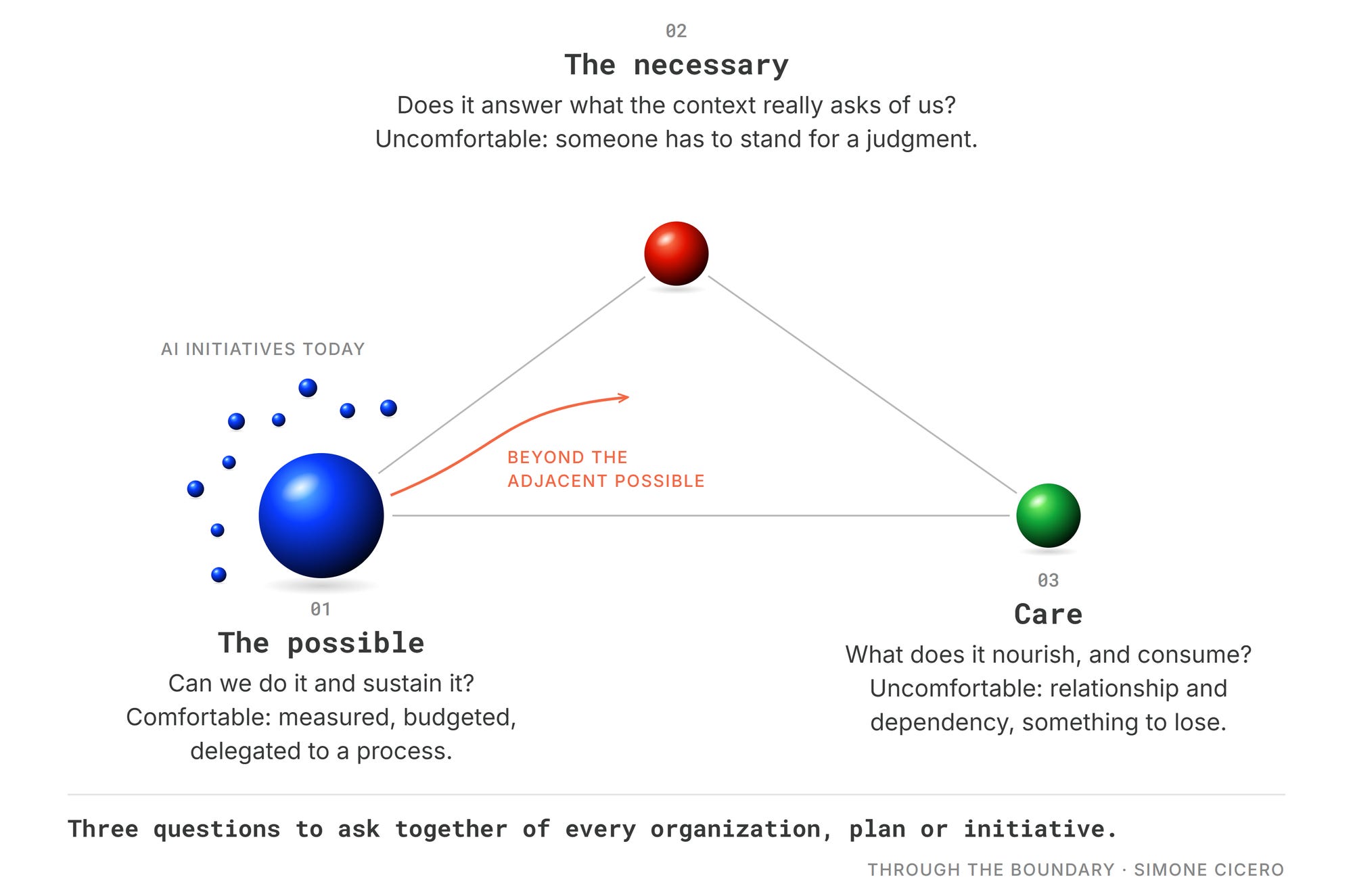
Turning this triangle into the next set of KPIs would mean capturing performatively the very thing it is meant to escape and make visible. The triangle should be a deliberative instrument, as it brings up three questions to ask together of every organization, plan, or initiative.
Can we do it and sustain it (is it possible)?
Does it answer something the context really asks of us (is it necessary)?
And – eventually – what does it nourish, and consume, in all of us, in customers, or places?
But why should organizations care about extending beyond simple productivity gains? Because everybody has the same models at the same price and capacity freed without a destination flows into just more performance. Those who want to stay inside the productivity lens will find that productivity gains alone simply do not add up.
The rest of this piece lays out a proposal for those who want to step out of this race to the bottom.
The necessary calls us into question
The first uncomfortable space. The necessary is recognizing our responsibility to what we depend on. Think of climate, of the degradation of a territory, of lost trust in a community, of the crisis of meaning in work. We can produce analyses, strategy documents, business cases and action plans, and we can hand much of their drafting to AI. Yet the recognition of the necessary stays incomplete if nobody feels genuinely called into question.
To be recognized, the necessary needs someone who recognizes it as their own.
In another piece (“The investment cycle is turning inside out.”), Indy adds that an economy can be desperate for transformation and still structurally unable to recognize it and commission it. Budgets preserve inherited categories, procurement reproduces familiar specifications, and shared capabilities are structurally complex to budget for. I see this inside large organizations all the time: countless enabling teams do work necessary for everyone, struggle to get funded because they have no external customer, and are often devalued and unseen.
Here AI makes visible a difference we could ignore before: the one between a growing capability and legitimacy. Agentic capabilities can formulate countless strategies, propose investments, spot contradictions and coordinate processes. But the availability of those capabilities raises another question: who has the right to decide, on whose behalf, with what responsibilities, and with what consequences? And with what information available?
These are institutional questions.
As execution becomes delegable, it becomes clear that legitimacy does not derive from the ability to execute.
Legitimacy is the one thing an organization cannot buy from its model provider: as my friend Alessandro Pirani put it in a conversation recently:
who answers for what we depend on?
Recognizing and deliberating in favor of the necessary needs new institutional agreements on their own.
Care is part of the work
When I told the story of that week in the mountains, I had described the charcoal fire almost as an excuse: the real reason we went there was to be together. The charcoal makers who practiced the trade decades ago didn't spend a week in the mountains on holiday: they had work to do, a material necessity, responsibilities to share, and conviviality grew out of that work.
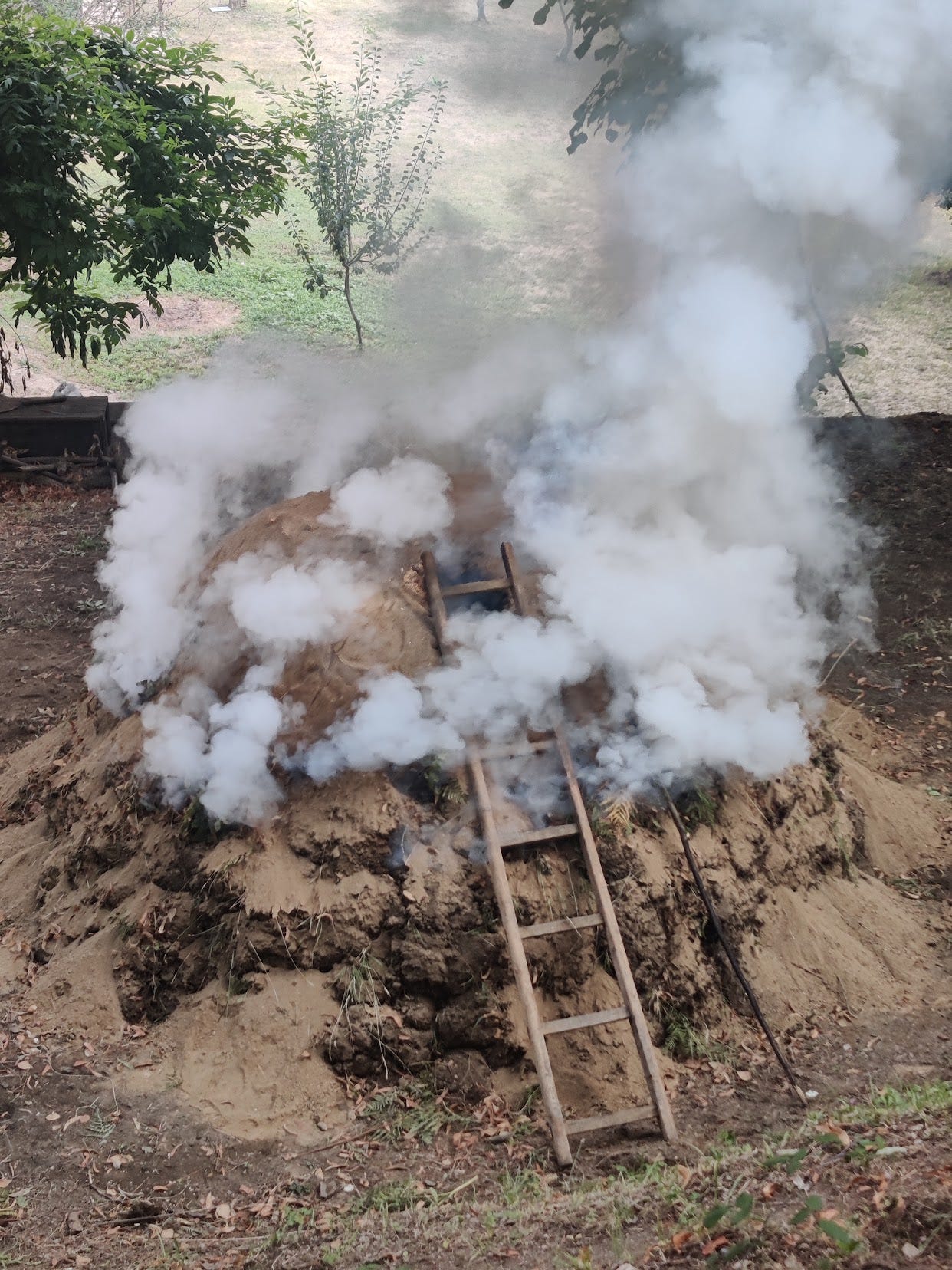
I recognize that we built that very experience around such work of care, and we ended up irritated with whoever came only to enjoy the sunshine and the meals without contributing to the organizational machine in the background: night shifts, cooking, cleaning, caring for the kids.
The production of charcoal was, in reality, the very condition that made that form of relationship possible.
That week had two faces: there wasn't only the fire to tend – on five or six days of continuous attention – as a responsibility toward something that could be lost and burnt to ashes; there were also the evenings, the dinners, the music, the hours without a purpose: care as being together, without having to become or produce anything. Organizations will gladly accept the first face, because it resembles work. The second is the one they always lose.
In 1973, Ivan Illich called convivial the tools and institutions that let people act autonomously and in relationship, rather than making them dependent on the apparatus, a criterion for judging institutions of care that was far from a wellness supplement.
And if it’s true that commons – as Elinor Ostrom noted – are kept up by clear rules, it’s also true that they often sit in a web of caring relationships of presence. The acequias of New Mexico, irrigation canals governed in common for centuries, are maintained through the yearly limpia, the spring cleaning of the ditch. Every water-rights holder owes a stretch of canal, and whoever doesn’t show up pays a fine; yet it is also one of the few days in the year when neighbors who rarely see each other work side by side. The convivial part is how a community recognizes itself as one before it has to decide or protect anything.
Now the new question, the one that concerns organizations built around AI directly: what happens when we can produce the charcoal without working together?
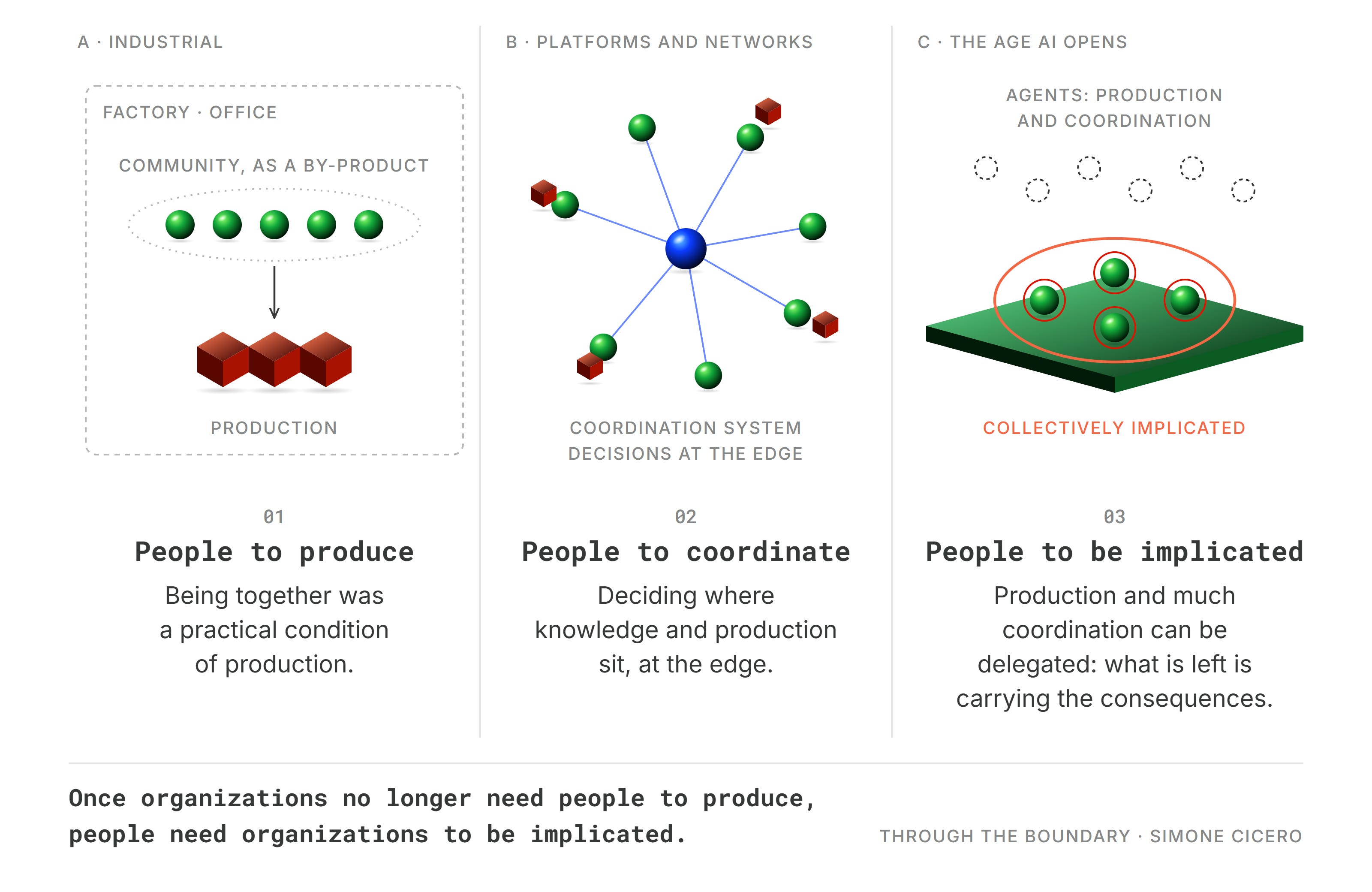
In the industrial age, people were needed to produce, and being together was a practical condition of production: community was a by-product of the factory and the office. In the second, the age of platforms and networks, the organization became a coordination system, and people were needed to coordinate and to decide where knowledge and production were localized at the edge. In the upcoming age that AI opens, I argue that production and much of the coordination can be delegated, and organizations represent a way for people to do something different: to be collectively implicated.
As the shift empowers the edge more, people, who carry the consequences, need organizations to steward relationships and make legitimate decisions. Once organizations no longer need people to produce, people need organizations to be collectively implicated, and that is a different organization.
The disembodied organization, existing in nothing and in no place, will struggle in this age because it has no legitimacy to spend.
The implicated subject
So if we frame the human beyond a residual productive capacity not yet captured by the machine, or a supervisor of it, the hypothesis of this piece is that the human – in the age of AI – needs to be a collectively implicated and instituting subject. People should then take part in recognizing what matters, take responsibility for the consequences of collective action and actively build the conditions in which that action can make sense – involved in the material, relational and political consequences of the organization's decisions.
People can still lose something. They are transformed by what happens. They have to live with the effects of the choices. And they must be able to take part in deciding which choices to make: having a real place, community or context in the world they are helping to transform.
The problem – of course – is that in modern organizations, our recognition is tied to what we know how to do: we are designers, managers, analysts, developers, and we are recognized for the outputs of that know-how.
When a growing share of those outputs can be produced by an artificial system, recognition based on output empties out, and we're in a crisis of recognition.
What we are called to institute
If the meaning of the human moves along these lines, the next question is which institutions allow people to be implicated in practice because an organization can ask its members to care about the mission without giving them any real chance to influence it, and that would just be another form of performative capture, perhaps the most demanding one: turning implication into a motivational requirement.
We need institutional conditions of participation and responsibility.
In her new book, Nilofer Merchant uses a phrase I have thoroughly adopted: our best work. Her argument is that the conditions under which people can do their best work are a commons, protected by rules with consequences, and that, at work, what happens is what we allow to happen.
In a few words, the antidote to performative capture cannot be anything other than the collective stewardship of the conditions under which work happens.
What has to be instituted is therefore the language of the work: an ontology, in the loose sense of the word, of what exists in the organization, what it is called, what counts as an offering, a unit, an agreement, a cost and as value. We also need to set the conditions for how we work together: the contracts. Who decides what, who answers for what, what a team can do without asking, what it can buy, how a budget moves. The operating model.
These two are enabling constraints that let the organization adapt, rather than obey tired top-down management rules.
A third aspect is – I believe – the rituals: the time that escapes from accounting, and not necessarily and not only the productive rituals of decision-making but the convivial ones, those that cannot be measured with an indicator, those that exempt from measurement. Byung-Chul Han has written that we live in an age of communication without community, and that rituals are the forms that make time inhabitable: well, an organization that has only productive processes has no time to inhabit.
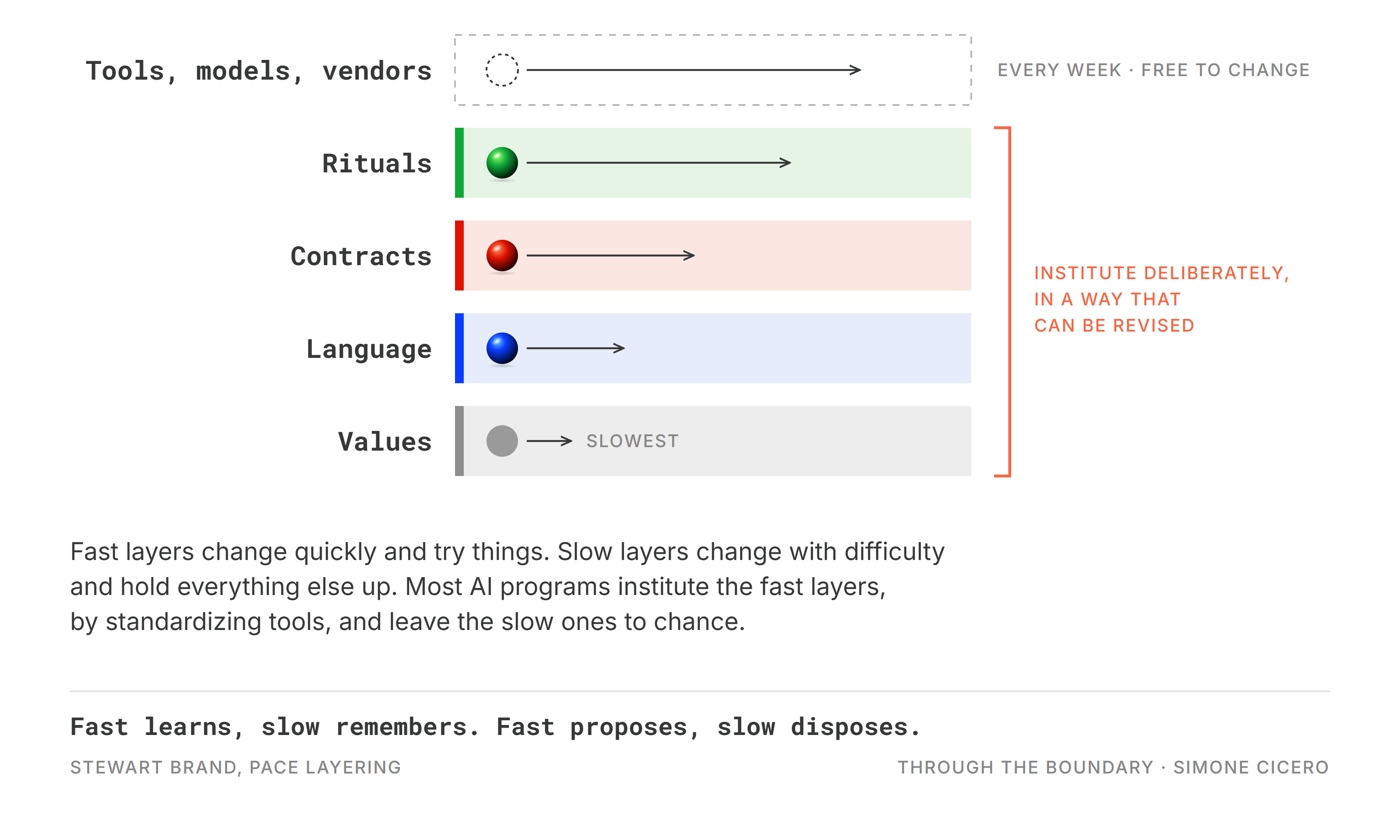
Language, contracts and rituals are the slow layers of the organization, together with its values. Everything above them- the tools, the models, the vendors- changes every week and should stay free to change. Stewart Brand called this pace layering.
Most AI adoption programs today make the mistake of instituting the fast layers by standardizing tools and leaving the slow ones to chance. Unfortunately, the slow layers get instituted anyway, by accident: provisional work streams drafted in a hurry to catch up with agentification, because our stakeholders expected it last month, become organizational structures and, as Mel Conway described, deeply influence the work that gets done in the end.
Today, as we've already seen, a key responsibility should be to design our institutions deliberately, creating the conditions for our best work.
Agents will happily write 100 pages of organizational ontology, but they cannot decide who takes part, who answers, and what we want those rules to protect.
How an existing organization gets there
Most organizations have deeply coded stakeholders, and are often implicated in nothing: disembodied by construction, only chasing the next quarterly updates. So how does such an organization move from the possible to the necessary and to care?
The honest answer is that it does it gradually. A listed company does not wake up one day caring about the necessary. But a bunch of routes represents credible options already today.
The first route is what we call at Boundaryless regenerative constraints. Regenerative constraints are intentional limits an organization sets, based on decisions to design the conditions for it to recreate its value frameworks. These necessary constraints work along with the constraints of the possible and hold units responsible not only for P&L but also for outcomes the market does not pay for right away: the origin of materials, a territory, a relationship with a community, an ecological threshold.
The key point is that these constraints can be written in the same language as the contracts between units, so units can institute them without resorting to top-down bureaucracy.
If for shareholders financial returns are – as Indy puts it – claims on the future, their value depends on the maintenance and care of the substrate that makes them enforceable: water, soil, trust, community and license to operate. A regenerative constraint is effectively a way to maintain such a substrate.
While the triangle can be a lens through which the organization deliberates, the constraints are, effectively, the instituted result of that deliberation.
A tension to keep
One risk remains: replacing the productive human with the eternally responsible human, a subject who must always commit, care, take part and answer the problems of the world… would be just another performance, perhaps more demanding than the one we started from.
This is why care matters: people expose themselves in the space of the necessary, take risks and say "this matters" only if there is a relationship that is not conditional on what they produce. Conviviality is the unconditional relationship, and without it implication burns people out.
Care and relationships are what make committing to the necessary bearable.
This brings me back to the original sense of the piece I started from. People have value and a right to relationship, even when they aren't taking on responsibility, contributing to a community, or solving a necessary problem. Care includes gratuity, presence, play, and rest. On the human plane, relationship and care need no justification by their usefulness. On the organizational plane, when we want those conditions to last, we have to organize, sustain, and institute them.
AI is calling into question an assumption of modern organizations: that the meaning of human participation lies in productive contribution. As the capacity to execute grows, the capacity to recognize what is necessary, take responsibility for what we depend on, and build the conditions for our action together becomes more urgent.
The task is not only to design organizations able to use AI. It is also to design organizations where expanding the possible does not erase our ability to recognize the necessary and care for it, and for us, together.
Curated Links
The Rise of the Self-Driving Company
The program this issue argues with, written out in full by Replit: people set direction, agents carry intent through to execution, and the firm gets redesigned around the collapse of coordination costs. To their credit, they name governance as the real obstacle and propose what they call an Agent Habitat. Read it with one question in mind: who answers for what happens inside the habitat?
Why Focusing on AI Adoption Is a Losing Strategy
A nine-month Amazon study of more than 10,000 practitioners finds a 58x gap in value between people who use AI on isolated tasks and people who redesign whole processes with it. What moved people up was community, escalating challenge and accountability, in that order, and leaders who took shame and fear seriously.
The investment cycle is turning inside out
The piece behind the section on the necessary. Indy Johar shows how an economy can badly need a capability and still be unable to commission it because no single budget captures enough of the benefit. His answer is to construct demand on purpose, and he is clear that whoever organizes demand decides which needs become visible: the legitimacy question, at civic scale.
When it’s time to say goodbye
Francesca Pick - a friend and founding member of Greaterthan Collective reflects on closing it after nine years. It is an honest side of the charcoal story: collectives that run on care wear out too. Her advice is to notice the climate earlier, hold the initiative less tightly, and ask for outside help sooner.
Towards a Theory of Agents
A demanding research program on agency under uncertainty and irreversibility. The part that matters for this issue: agents that optimize averages and trim their safety margins fall into an efficiency trap, and slack, reserves, and human circuit-breakers turn out to be the reflex layer that keeps an institution alive.
Callbacks
The argument this issue extends:
TTB 7, Legibility Is Cheap, Implication Is Not, where I argued that what matters is having something you can lose. This issue takes the same claim inside the organization to the people who work there.
TTB 1, What is an Organization today?, the question this issue reopens from the side of the people who make an organization up.
Work Updates
O2A 1.0 is coming. In the coming weeks, we publish O2A 1.0, the stable release of our standard for describing an organization as units, the offerings they make to each other, and the agreements between them. Beyond those basics, 1.0 will introduce dependencies between offerings, so a unit can state which offerings it relies on, and ten offering archetypes, recurring types such as professional service or managed service, each with the business equations that fit it. The release also comes as a downloadable package with a machine-readable schema, for those who want to configure an organization with their own tools or agents. On this issue, we're trying to write down the language and the contracts. Check out the current version on docs.boundaryless.io, next to the rest of our methodology.
What to do next?
If you are designing an AI program and want to ask the other two questions- the necessary and the care- alongside productivity, I would genuinely be interested in working on this with you.